
Ireland and UK · October 2026
We checked over 3,600 Christmas and January foods. Here's what we found.
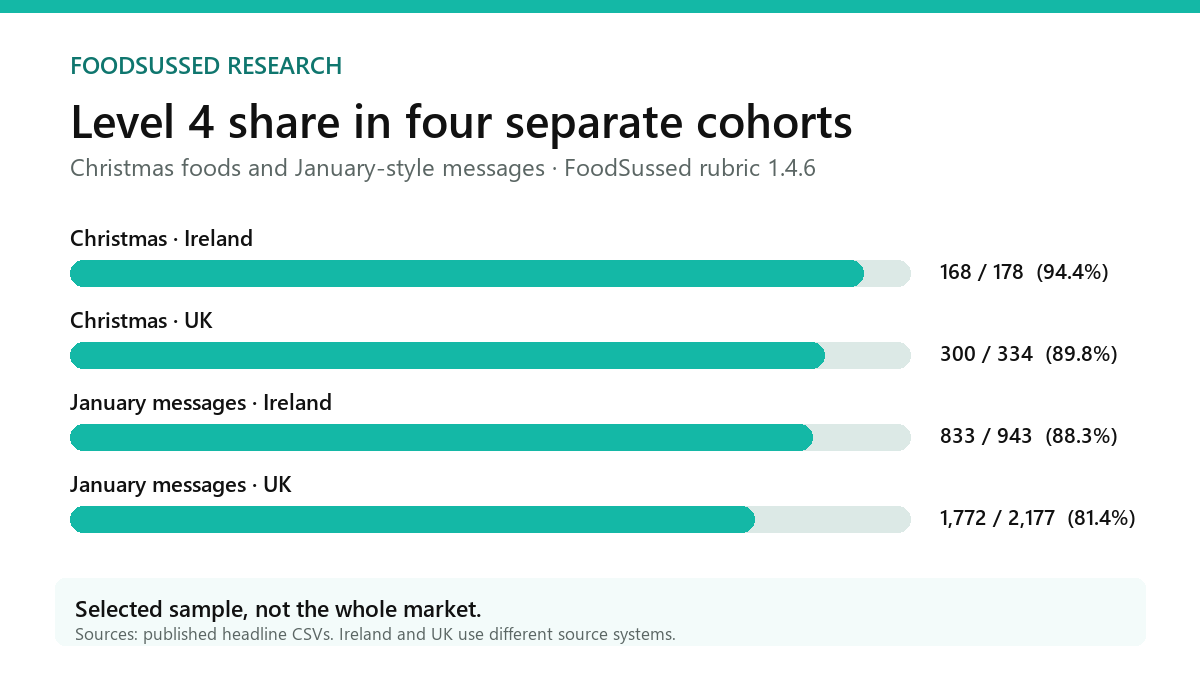
Most came out at Level 4, the most processed group in FoodSussed's ratings. That was around 9 in 10 Christmas foods, and 8 to 9 in 10 foods sold with messages like high protein, low fat or light.
A "high protein" or "low fat" message tells you about one nutrient. The ingredients list tells you how the food was made.
These are our FoodSussed ratings for a selected sample, not every product on the shelf. Level 4 doesn't automatically make a food unhealthy.
By Keith O’Beirne · 23 October 2026 · No Nonsense Fitness. Sources: Irish shop listings and UK product records.
What we found
The four numbers.
- Christmas, Ireland: 168 of 178 shop listings (94%) were Level 4.
- Christmas, UK: 300 of 334 products (90%) were Level 4.
- "High protein", "low fat", "light" and meat-free, Ireland: 833 of 943 shop listings (88%) were Level 4.
- The same messages, UK: 1,772 of 2,177 products (81%) were Level 4.
The table gives each result, its source and shops. On a phone, swipe the table sideways.
| Sample | Share at Level 4 | Level 4 / checked | Source | Shops |
|---|---|---|---|---|
| Christmas · Ireland | 94.4% 95% CI 90.0–96.9% | 168/178 | Tesco, Dunnes and Lidl listings counted per shop listing | Tesco 93 · Dunnes 79 · Lidl 6 |
| Christmas · UK | 89.8% 95% CI 86.1–92.6% | 300/334 | UK products in a public food database counted per product | Public database; shop not recorded |
| January · Ireland | 88.3% 95% CI 86.1–90.2% | 833/943 | Tesco, Dunnes and Lidl listings counted per shop listing | Tesco 464 · Dunnes 315 · Lidl 164 |
| January · UK | 81.4% 95% CI 79.7–83.0% | 1,772/2,177 | UK products in a public food database counted per product | Public database; shop not recorded |
Ireland and the UK use different sources, so don't compare the two countries. Christmas foods include year-round extras like stuffing and gravy. The full list of limits is in the method section below.
Real products
What it looks like on the shelf.
Some familiar products from the UK sample, with their Level and the ingredients that put them there. A Level belongs to that one product, not the whole brand. Some products in the same aisle came out at Level 1, so a Christmas label or a January message doesn't decide the Level on its own.
Christmas
| Product | Level | What put it at Level 4 | Barcode |
|---|---|---|---|
| Cadbury Heroes Chocolate Tub, 660 G Cadbury, Mondelez | Level 4 | colours, milk powders or proteins, emulsifiers, moisture-keepers, glucose syrup and related carbohydrates | 7622210707338 |
| All Butter Mince Pies Aldi | Level 4 | milk powders or proteins, glucose syrup and related carbohydrates | 4088600560724 |
| Black Forest Christmas Pudding Marks & Spencer, Marks & Spencer Collection | Level 4 | colours, emulsifiers, flavourings, moisture-keepers, glucose syrup and related carbohydrates, protein isolates | 00994835 |
| British Outdoor Bred Pork and Cranberry Stuffing M&S Collection | Level 4 | flavour enhancers | 00247467 |
| Bisto Best Chicken Gravy Bisto | Level 4 | colours, emulsifiers, flavourings, flavour enhancers, glucose syrup and related carbohydrates | 5000354905001 |
| Beef Gravy Asda | Level 1 | No Level 4 ingredients | 5063089966389 |
| Beef Gravy Specially Selected | Level 1 | No Level 4 ingredients | 4088600527147 |
January-style messages
| Product | Level | What put it at Level 4 | Barcode |
|---|---|---|---|
| ASDA Plant Based 12 Meat-free Meatballs Asda | Level 4 | flavourings, glucose syrup and related carbohydrates, added fibre, protein isolates, stabilisers, thickeners | 5057172279937 |
| Active Low Fat Yogurt Strawberry Brooklea | Level 4 | flavourings, modified starch | 4088600010212 |
| Asda Light Mayonnaise Asda | Level 4 | colours, milk powders or proteins, flavourings, added fibre, modified starch, thickeners | 5054781313090 |
| Alpen No added sugar Alpen | Level 4 | milk powders or proteins | 5010029228304 |
| 0% added sugar 0% fat strawberry Actimel Danone | Level 4 | flavourings, modified starch, stabilisers, sweeteners, thickeners | 5060058332152 |
| Aberdeen Angus Lean Beef Mince Asda | Level 1 | No Level 4 ingredients | 5054781854418 |
| Fat Free Natural Greek Style Yogurt Brooklea | Level 1 | No Level 4 ingredients | 4088600284941 |
Each barcode links to its public product record, which can change. Check the current pack. We don't republish ingredient lists or pack images.
What the ingredients do
The ingredients behind most Level 4 ratings.
These came up most often. The additives among them are all approved for use in the EU. Knowing what each one does is the point. It isn't a warning.
- Flavourings: add or boost taste.
- Glucose syrup and related carbohydrates: glucose syrup, dextrose and maltodextrin come from starch; invert sugar comes from table sugar. They provide sweetness, bulk or texture.
- Emulsifiers: help oil and water mix and stay mixed.
- Colours: add or restore colour.
- Flavour enhancers: make savoury flavours stronger. MSG is one.
- Sweeteners: provide sweetness instead of sugar; their calorie content varies.
- Thickeners: give a yoghurt or sauce its thickness.
- Stabilisers: keep the texture consistent.
- Modified starch: starch treated so it thickens or holds up better in processing.
- Protein isolates: protein taken out of milk, soy or peas and added back in.
- Milk powders or proteins (like whey): parts of milk added on their own.
- Added fibre (like inulin): fibre taken out of plants and added in.
- Moisture-keepers: stop food drying out.
FoodSussed explains each additive using the European Commission's list of approved additives and what they're used for.
Most common in each sample
Christmas, Ireland: flavourings, glucose syrup and related carbohydrates, emulsifiers, colours, flavour enhancers.
Christmas, UK: glucose syrup and related carbohydrates, flavourings, emulsifiers, colours, flavour enhancers.
January-style messages, Ireland: flavourings, sweeteners, thickeners, colours, stabilisers.
January-style messages, UK: flavourings, thickeners, protein isolates, colours, glucose syrup and related carbohydrates.
Exact counts for each sample are in the method section and the downloads.
For journalists
Using this research.
Summary. In October 2026, No Nonsense Fitness checked Christmas foods, and foods sold with messages like high protein, low fat and light, using FoodSussed's ingredient-based processing ratings. In Ireland we checked Tesco, Dunnes Stores and Lidl listings. In the UK we checked products in a public food database. Level 4 is the most processed group. Christmas: 168 of 178 Irish listings (94%) and 300 of 334 UK products (90%) were Level 4. "High protein", "low fat", "light" and meat-free: 833 of 943 Irish listings (88%) and 1,772 of 2,177 UK products (81%). These are selected samples, not every product on sale, and a Level is not a health score.
Suggested citation: No Nonsense Fitness / FoodSussed, Christmas and January food processing study, October 2026, nononsensefitness.ie/christmas-january-food-processing-study/
Data: download the results as CSV. Contact: Keith O'Beirne, founder, keith@nononsensefitness.ie.
Full method and limits
How we did it, in full.
Disclosure: No Nonsense Fitness makes FoodSussed, the app promoted below. This analysis reports outputs from our own ingredient-only, NOVA-informed rubric, version 1.4.6. It does not independently validate the rules against expert NOVA assessments or measure health outcomes.
Exact counts behind each Level 4 rating
Most frequent Level 4 driver categories per sample (a product can have several, so counts overlap). Christmas Ireland: flavourings 129, glucose syrup and similar industrial sugars 107, emulsifiers 100, colours 78, flavour enhancers 66. Christmas UK: industrial sugars 208, flavourings 161, emulsifiers 157, colours 139, flavour enhancers 77. January Ireland: flavourings 626, sweeteners 392, thickeners 335, colours 304, stabilisers 232. January UK: flavourings 1,379, thickeners 742, protein isolates 651, colours 575, industrial sugars 535. These are rule markers, not measures of toxicity or causes of harm.
How the foods were selected
Christmas matching used recorded names and categories for festive foods, named chocolate assortments and requested accompaniments such as stuffing, gravy and cranberry sauce. Those accompaniments can be sold year-round. Non-food, drink and unrelated meal matches were filtered; this is not a survey of the current Christmas shelf.
January matching used recorded nutrition and fitness wording, including protein, low-fat, reduced-sugar and diet messages, plus meat alternatives identified by both a plant-based qualifier and a meat-format name. Light/lite needed a relevant dairy, spread or dressing format. Plain plant foods were not included just for being plant foods. These are metadata proxies, not independently verified pack claims. Lean meat can qualify; not every record is marketed as healthy.
Completeness and language checks
The frozen rubric checked declarations for known problems and apparent completeness before scoring. Missing, incomplete, very short, damaged, uncertain or otherwise unscorable declarations stayed out of the scored denominator. These are algorithmic checks, not verification against pack photos; source errors and generic compound ingredients can survive them.
The public-database records (UK and supplementary Irish) also received a locked offline English-language screen, with narrow frozen plain-food exemptions and no translation. That extra screen can reject short English declarations and raise the observed Level 4 share. The Irish Tesco, Dunnes and Lidl listings did not receive the extra screen: language labels can be unreliable for shared food terms and mixed-variety declarations. Irish provenance does not prove English. Rubric gates and scoring abstentions still applied; a German Lidl declaration found during review remained unscored. This does not establish that every retained declaration is English. No pending language-evidence cases remained.
Category hand-check and its limits
The final pooled category audit found Christmas false positives in 3/40 matches (7.5%) and January false positives in 0/40 (0.0%). Christmas had received the single permitted rule repair after the initial audit; January rules were unchanged.
These are pooled story checks across sources and countries, not separate error rates for each headline cell. The Christmas audit contained no Irish shop-listing records; the January audit had only limited Irish shop-listing representation. No separately measured Irish category error rate is established. The check tested metadata fit, not ingredient authenticity, completeness or current availability. Missed matches and residual errors remain possible.
Counting, duplicates and missing coverage
The 95% confidence intervals describe binomial precision only; they do not account for source selection, repeated variants or classification errors. Ireland counts retailer plus product ID, retaining the latest listing across pull pages before selection and scoring. The same product can remain across retailers, pack sizes and flavours. The UK counts barcodes within the exact database country tag; a barcode tagged to both countries can appear in both supplementary country files. Neither unit is a deduplicated recipe family.
The Irish shop-listing data has incomplete retailer coverage and no UK coverage. The public database is contributor-selected; country tags do not prove current shelf availability. Missing declarations, recipe errors and historical records affect both selection and scoring. Neither source supplies a national sampling frame. The supplementary Irish files are not pooled into the Irish headlines, and the unavailable UK shop-listing files must not be treated as measured zero rates.
Processing is not healthiness
Level 4 estimates processing markers from a recorded ingredient list; it cannot inspect manufacturing. It is not official NOVA, a health score, a food-safety assessment or advice to avoid a product. Nutrition, portions and someone’s overall diet are separate questions. No country, retailer or brand health ranking follows from these results. The yogurt comparison samples were too thin for a comparison headline.
For Level definitions and worked examples, see how processed is your food? Our UK protein-products study uses a different sample and earlier rubric; its rates should not be pooled with this study.
Check the numbers
Download the scored results.
Each file contains name, brand, retailer where available, barcode for public-database records, Level and driver category codes only. No ingredient text, matched ingredient fragments, raw supplier rows, supplier IDs or supplier URLs are included. Import barcodes as text to preserve leading zeros.
The headline files let you recount the published fractions. The supplementary Irish files are provided separately. Without declarations, excluded records or selection metadata, these downloads cannot reproduce the classifications or the full selection process.
- Christmas · Ireland · research data CSV — Headline sample.
- Christmas · Ireland · supplementary research data CSV — Supplementary Irish sample; not the Irish headline.
- Christmas · UK · research data CSV — Headline sample.
- January · Ireland · research data CSV — Headline sample.
- January · Ireland · supplementary research data CSV — Supplementary Irish sample; not the Irish headline.
- January · UK · research data CSV — Headline sample.
FoodSussed · Coming soon to Google Play
Read the list in your hand.
FoodSussed brings the check to the ingredient list in your hand, with your food diary alongside it.
- Snap the ingredients. Review the text read from your photo, then see an estimated level and its reasons.
- Scan and log. Use available barcode data to record calories and macros.
- Review your week. See your logged food, weight trend and processing levels together in a weekly review, on the day you choose.
The Android app is not on Google Play yet.
Related research
See more of our research, start with our guide to food processing, or read the separate UK protein-products analysis. Keep the different samples and methods in mind.
General education. Processing estimates depend on recorded declarations; no clinical or dietary conclusions follow.
Data: Open Food Facts contributors (ODbL) and BasketWatch Irish retailer listings.