Short version: I like Professor Nutz and have ordered it for years. It gives me the peanut-butter taste for a smaller stated calorie cost than a standard jar. But its calories are “digestibility corrected” by the manufacturer. They are not ordinary nutrition-label values that I can independently verify, and the small study on the brand’s site does not prove them.
MyCore Supplements is a partner brand. I bought Professor Nutz before that partnership existed. See the full partner disclosure.
MyCore Supplements reader code
Check Professor Nutz at MyCore →
Not valid on items already reduced. MyCore ships from Cork. MyCore lists free Ireland delivery on orders of €75 or more; check the final delivery charge after applying the code.
What I would tell a friend
This is not normal peanut butter with the fat pressed out. That line was in the old version of this page and it was wrong. Professor Nutz says added fibre changes how much fat and carbohydrate are digested. The company also says the amount digested varies from person to person.
That leaves a simple split. Taste and texture are things I can judge from using it. The numbers below are what the maker publishes. They are useful for checking one flavour against another, but I would not call them independently proven calories.
I have ordered from MyCore most months for years. Professor Nutz, protein bars, whey and vitamins are the things that keep making it into my basket. DPD delivery has been fast in my experience. When something was out of stock, MyCore contacted me on WhatsApp and asked what I wanted instead. That is my order history, not a promise that every delivery will be identical.
Professor Nutz calories and macros by flavour
These are the figures on the manufacturer’s product pages, checked on 10 September 2026. “Digested” is the brand’s wording. It is not the same as a standard total-fat or total-carbohydrate declaration.
| Flavour | Serving | kcal | Protein | Digested carbs | Digested fat | Fibre | Sugars |
|---|---|---|---|---|---|---|---|
| Original | 32g | 36 | 7g | 0g* | 0g | 3g | 2g |
| Caramel Kiss | 32g | 40 | 7g | 3g | 0g | 3g | 3g |
| Coconut Macaroon | 32g | 40 | 7g | 3g | 0g | 3g | 3g |
| Cookie N Cream | 32g | 64 | 7g | 9g | 0g | 2g | <1g |
| Pistachio | 32g | 44 | 7g | 4g | 0g | 3g | 3g |
| Chocolate | 32g | 36 | 7g | 3g | 0g | 3g | 3g |
*The Original page’s HTML says 0g digested carbohydrate. Its nutrition-panel image says 2g. MyCore’s Original listing also shows an older 28 kcal claim. The Birthday Butter page displays a table headed “Pistachio” with a 34g serving, so I have left Birthday Butter out rather than pretend the data is clean. The jar in hand wins when these pages disagree.
What changed: the old page used Caramel Kiss’s 40 kcal and 7g protein as if every flavour matched it. It then calculated 17.5g protein per 100 kcal and called the calories verified. That was too certain. The flavour pages differ, fibre was left out of the arithmetic, and the manufacturer itself says absorption varies.
What “digestibility corrected” means here
Professor Nutz says fibre binds some fat so less of it is digested. The product pages then report “total digested fat” and “total digested carbohydrates” rather than just the amount physically present in the food.
I cannot turn that into a confirmed calorie figure with the usual 4/4/9 calculation. Fibre also has an energy factor under EU labelling rules, and the full composition is not published in a form that lets me independently reproduce the result. So the honest description is the manufacturer’s digestibility-corrected claim, not a verified calorie count.
This is why I removed the old comparison with eight Open Food Facts peanut butters. A normal jar’s label and a digestibility-corrected claim are not clean like-for-like data. The site’s protein-per-100-calories comparisons use ordinary label figures; this product needs the caveat above.
What the six-person study actually tested
The study on the company’s site was a randomised, double-blind crossover pilot. Six healthy men completed two two-week periods, separated by a four-week washout. They ate 160g a day of regular or modified peanut butter on top of their usual energy needs.
Fat mass rose significantly during the regular-peanut-butter period. It did not change significantly during the modified-peanut-butter period. Resting metabolism and lean mass did not change significantly.
The useful limit: the study measured body composition and resting metabolism. It did not directly measure fat absorption or the metabolizable calories in a 32g serving. Six men over two weeks is enough to call it a pilot, not enough to prove the jar’s calorie number. The paper reports funding from AD-TPS Ltd and declares no conflict of interest.
Taste, texture and the flavours I bought
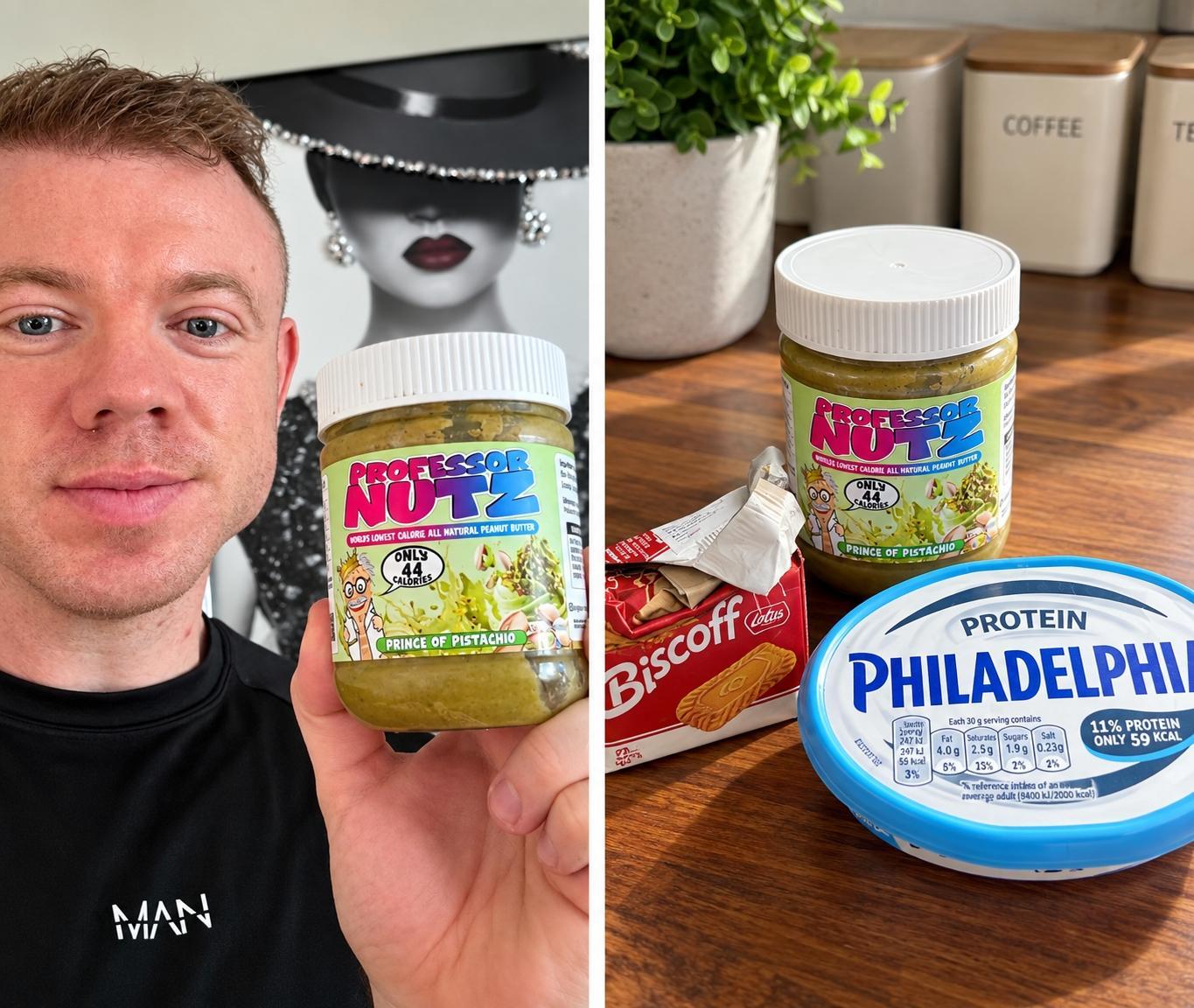
The texture is thicker and less oily than ordinary peanut butter. That is the trade-off. Prince of Pistachio is one I buy often. Chocolate has been my favourite when I could get it. The flavoured jars cover the texture difference better than Original for me.
A 32g serving is easy to misjudge on a spoon. A small-looking extra spoon can change the total quickly.
I often mix it with Philadelphia Protein soft cheese and crushed Biscoff. The old page gave that bowl a precise 259 kcal and 25.9g protein. Another page gave it 272 kcal. Both were wrong: the Philadelphia tub in the photo states 59 kcal per 30g, while the old sums used an older, much lower figure. I removed the total until every current label and weighed amount are together. False precision is no help. The food-label checker explains what to compare, and the tracker is there for recording the amounts actually used.
Where to buy it in Ireland
MyCore Supplements in Bishopstown, Cork lists Professor Nutz and ships from Cork. Stock, flavour choice and sale prices move, so I am not freezing a jar price into this review.
NNF10 gives 10% off full-price items. It does not stack with an existing sale price. The full MyCore review and discount page has the code steps, delivery notes and current terms. The reader-code list shows the other partner offers and disclosures.
Does it fit fat loss or muscle gain?
For fat loss, its appeal is obvious: the maker reports a smaller calorie cost for a peanut-butter-style food. The uncertainty around the digestibility-corrected figure means I would not build a tight daily target around the number as if it were independently measured.
For muscle gain, the 7g protein listed on each of the six usable flavour pages is useful, but it is still a spread rather than the backbone of a meal. The daily protein guide covers the bigger picture. The fat-loss guide covers why one jar matters less than the weekly pattern.
Frequently asked questions
How many calories are in Professor Nutz peanut butter?
The manufacturer currently lists different digestibility-corrected values by flavour, from 36 to 64 kcal per serving on the pages checked on 10 September 2026. Those are manufacturer claims, not independently verified metabolizable-energy measurements.
What are the Professor Nutz macros?
The six usable manufacturer pages each list 7g protein and a 32g serving, with 0g total digested fat, 0–9g total digested carbohydrate, 2–3g fibre and less than 1g to 3g sugars. The table above gives the flavour-level detail and flags the broken Birthday Butter listing.
Does the Professor Nutz study prove the calorie claim?
No. It tested body-composition and resting-metabolism outcomes in six men eating 160g a day. It did not measure the metabolizable energy in a serving.
What is the MyCore Supplements discount code?
NNF10 gives 10% off full-price items. It does not stack with sale prices.
Sources and checking notes
- Professor Nutz product pages for Original, Caramel Kiss, Coconut Macaroon, Cookie N Cream, Pistachio and Chocolate; checked 10 September 2026.
- Sharp et al. (2020), pilot crossover study PDF.
- EU Regulation 1169/2011 energy conversion factors.
Nutrition information is educational, not medical or dietary advice. Labels and retailer listings change. If a current jar disagrees with this page, send the label photo and the page will be corrected.